

No city on Earth is known for its dynamic and thriving film industry more than Los Angeles and
infamous Hollywood, but for nearly three decades, UK economic policies have demonstrated
their commitment to encouraging a flourishing film industry, from the renowned Pinewood studios
on the outskirts of bustling London to impressive investment in Shepperton Studios. An
underpinning feature of their policy has been the UK Film Tax Credit, which has been crucial to
encouraging investment and securing increased production across the UK.
Thousands of miles from the illuminated Hollywood sign and imposing Big Ben are the rolling
hills and pristine beaches that make up Cyprus, a small island in the Mediterranean known for its
rich cultural heritage and strong tourism industry. In recent years the Cypriot government has
introduced an upto 40% cash-back rebate to encourage international production companies to
choose their diverse landscapes. However, with a population 56 times smaller, a GDP over 100
times smaller, and a landmass just 3% of that of the UK, will Cyprus’s competitive tax rebate be
enough to help the small nation stand on the world stage as a film production hub?
So, grab the popcorn and sit back as we explore the world of film tax credits, delving into the
benefits they offer their respective countries and production companies, the criteria for eligibility
and their wider impact on the film industry.
UK Tax Credit
Film tax credits are typically offered by governments, whether in the form of cash rebates or tax
incentives, to encourage production companies to base within their borders – which would see
increased local investment through job creation, spending and tourism. Eligibility and
requirements of tax credits vary country-to-country, but generally, criteria must be met that’s
designed to augment culture and achieve specific policy.
Although the credit was introduced in the 2000s, evidence of UK government concern over
Hollywood’s influence on the industry was evident as early as the 1920s, as British Prime
Minister Stanley Baldwin was a strong advocate for stricter regulation to counter the negative
effects. Whilst combating a broad range of issues, the Cinematograph Film Act of 1927 worked
to define British films and encourage culture, which can be seen reflected in the tax incentives 80
years later.
Despite a post-war boom, the UK cinema industry had seen a sharp decline over the following 40
years, with the 1980s and 1990s defined by sluggish growth.
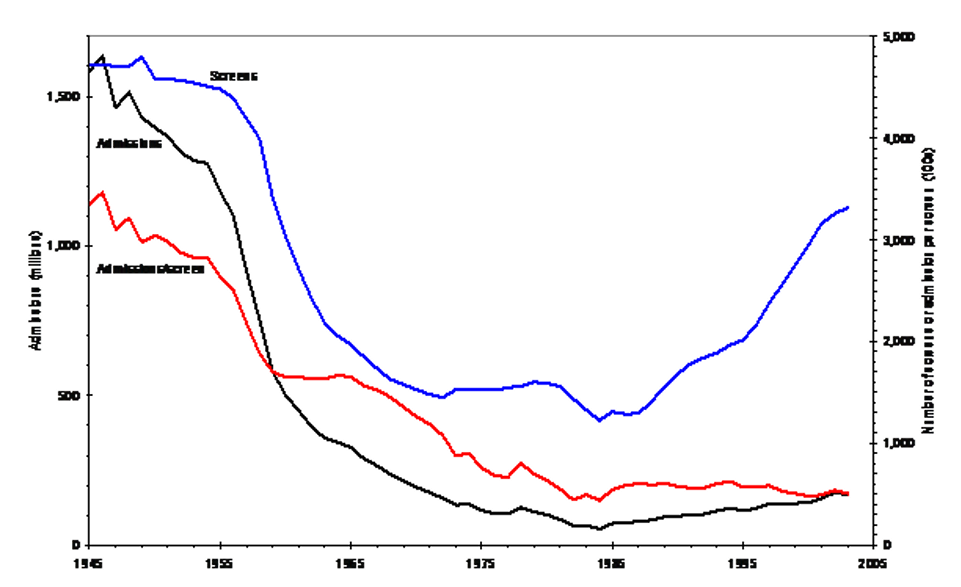
The UK Film Tax Credit was introduced in 2007 in the midst of an ambivalent UK film industry
that had been showing strains since the late 1900s. Although renowned for its strong heritage in
film production and despite impressive recent releases such as GoldenEye and Four Weddings
and a Funeral, the 1990s saw a period of economic struggles for the industry, partly due to
Hollywood’s continued dominance; in 1995, truly British films only represented 4.2% of UK box
office takings. [1]
[1] Dyja, Eddie. “BFI Film and Television Handbook.” 1997.
The UK tax credit is an economic policy built to revolutionise the industry, allowing production
companies to access a 25% tax credit of core UK qualifying spend, subject to a cap at 80% of
total expenditure. With no monetary cap on total spending or sunset date but, when introduced, a
requirement for a spend of around £1 million per hour, production companies were incentivised to
increase budgets, especially those at around £800,000 / hour, effectively gaining a fully credited
additional 25% budget. The credits became even more valuable as some banks began to allow
their use as collateral, meaning that other finance became more accessible.
Eligibility
Film producers and production accountants have a few barriers to consider before claiming – first
of which is whether their production is eligible. Firstly, a film production company must be
required to pay UK corporation tax, even if this is via an ‘off-the-shelf’ company setup by an
international parent company; in reality this creates a very minor obstacle.
A minimum UK core spend of 10% must be achieved, and then the film must either pass a
points-based cultural test, or be an official co-production within one of 12 countries that share a
bi-lateral co-production treaty with the UK / be a signatory to a European Convention.
The cultural test is made up of four sections which carry a maximum possible score of 35. A film
needs only 18 to pass, and points are allocated based on the importance of the particular criteria:
● Section A refers to Cultural Content, mainly requiring UK sets, characters, dialogue or
underlying material.
● Section B refers to Cultural Contribution, requiring a representation of British culture,
heritage or creativity.
● Section C refers to Cultural Hubs, with the aim of encouraging local elements of
production in the UK.
● Section D refers to Cultural Practitioners, awarding points for key staff members being
UK or EEA citizens and residents.
An alternative way to pass is the bi-lateral co-production treaty, which allows two countries to
collaborate on the production of a film, with a minimum co-producer contribution for each
producer of at least 20% of the cost of production (or 30% in Australia). In event of three or more
co-producers, the minimum contribution requirement falls to 10% in some cases.
Interestingly, in June 2021 the UK signed the revised European Convention, which introduced
the option to use reduced bilateral minimum finances to 10%, with multilateral finances to 5%,
but this application is only relevant where both countries have ratified the new convention.
Whilst there’s only 12 official UK bi-lateral co-production treaties, production companies can
co-produce even with countries where there is no treaty in place, but the cultural test must be
passed to be eligible for tax relief.
Qualifying Spend
Once passed, the producer and accountants must consider what makes up their qualifying
spend. Many aspects of pre-production, principal photography and post-production are included,
but a variety of spend is not, including development, distribution, commercial exploitation &
marketing, financier fees, bonds, capital expenditure, errors & omissions and abandonment
insurance, entertaining and accounting. And it gets evermore nuanced; audience previews and
questionnaires are not qualifying, but financier and producer previews are, whilst PACT spend is
not but Screenskills spend is.
It’s important to identify that the spend was used and consumed in the UK to qualify, and at
times, costs may need to be apportioned between UK and non-UK expenditure to identify the
correct tax credit available.
Considerations
UK productions are certified by the BFI, with an interim DCMS British Film certificate issued at
least 4 weeks prior to principal photography (valid for 3 years) and a final certificate issued after
completion and delivery. Payment is administered by HMRC and based on the company
statutory accounts and corporation tax return, with a turnaround time of approximately 28 days.
Multiple applications can be made in-line with the producers expected end of principal
photography to allow significant pro-rata’d amounts of the tax credit to be claimed earlier.
Structuring a film to take advantage of tax credits is crucial and can have material financial
implications; for example:
● Film production company A has a qualifying spend of £10m, and spends it all in the UK.
The tax relief is subject to the 80% cap of total core expenditure, so 25% of £8m would
be claimed at £2m
● Film production company B has a qualifying spend of £10m, and spends £8m in the UK.
The spend itself is 80% of the total core expenditure, so all £8m is eligible for tax relief,
netting a relief at £2m. However, the remaining £2m of the budget can be spent in
another country that allows co-productions, whether via official treaty or if the UK cultural
test and the third party criteria is achieved, to claim further tax credits.
As a result of its early spending decisions, company B has more opportunities to claim additional
tax relief and incentives.
Effectiveness of the UK Tax Credit
The UK tax credit scheme is a generous scheme that has undoubtedly strengthened its film
industry. According to the BFI, the gross value added (GVA) as a result of the UK’s screen tax
relief schemes in 2019 is £13.48 billion, an increase of 23.7% over the three years 2017-2019,
and creating 219,000 jobs. Of this, the film tax relief specifically generated £7.68 billion. [2]
Evidence of increasing usage of the tax relief is encouraging. Expenditure has been above £2
billion per year between 2019 and 2021, compared to £849.2 million in 2007. [3] Additionally, new
schemes inspired by the UK Film Tax Credit have been introduced, such as the Video Games
Tax Relief in 2014.
The BFI estimate that every pound of film tax relief generates £8.30 additional GVA, directly
supported by between 40-60% of below-the-line spend of 3 analysed films being on general
economy sectors. [4]
[2] [3] [4] BFI “New report shows UK tax reliefs power unprecedented boom in UK screen industries” 2021.
Whilst the tax credit may increase the competitiveness of the UK film industry, many have made
arguments against the tax credit; as it stands, it’s undeniable that bigger budget, commercial
projects are prioritised given the minimum spend and complexity, with smaller, independent films
less able to access tax credits. Additionally, the tax credit remains a costly subsidy to the film
industry and naturally the funds could be spent elsewhere.
Despite these arguments, the tax credit is widely considered to be a key factor in the success of
the UK’s film industry, creating jobs, enhancing economic activity and increasing the international
profile of the UK as a film-making hub, attracting unprecedented funding.
Cyprus’s Film Production Tax Rebate
The Cypriot economy is classed as a high-income economy according to the World Bank, and
features as an advanced economy in the International Monetary Fund’s list. Despite a financial
crisis between 2012-13, the country is characterised by a high standard of living and well
developed tourism and service sector.
With its picturesque landscapes dotted with ancient ruins, stunning beaches and rugged
mountains, crystal clear waters and diverse fauna, it’s understandable why the Cypriot
government introduced financial incentives in the 2018 Cyprus Filming Scheme, offering the
highest rebate in Europe.
It’s government had offered grants in the past, with €850,000 set aside in the national budget in
2000, and Cypriot films were eligible to claim funding from the Council of Europe’s Eurimages
Fund, financing co-productions, but the Cyprus Filming Scheme was a package of incentives not
seen before, quickly worth over €20 million.
‘Olivewood’, the term used to describe Cyprus’s determination to become a premier film
production destination, offers incentives for qualifying productions including feature films of at
least 1 hour length (45 minutes for IMAX), television films, series and mini-series, creative
documentaries, animated films and reality programs.
There’s a range of incentives available, including cash rebates or tax credits, VAT reimbursement
and investment tax allowances. Film production companies can choose one of the following two
options:
Cash Rebates
A rebate of upto 40% on eligible in-country expenditure is available, where the minimum total
expenditure is €200,000 for feature films. The eligible expenditure must not exceed 50% of the
total production budget, and the maximum rebate per production is €650,000, after an audited
report is produced and submitted.
The split has currently increased with a 40% rebate available on qualifying BTL expenditure, and
25% rebate on qualifying ATL expenditure.
Similarly to the UK, the Cypriot rebate is reliant on a cultural test, however, the production is able
to promote Cypriot, European or world culture, far more flexible than the UK cultural test.
With the impressive rebate, Cyprus is a strong contender to become a minority co-production
location, and has the potential to work very well alongside UK productions where the 80% cap
limits the effectiveness of UK tax credits.
Tax Credits
Production companies can claim 35% of eligible expenditure made in Cyprus in the form of
reduced corporate tax rates, with a cap on total credit being 50% of total taxable yearly income
during the year of production. In event of exceeding the cap, the credit can be carried forwards
for upto 5 years. Minimum expenditures remain at €200,000 and cultural tests continue to apply.
Eligibility
The applicants must be private sector companies, carry the initials AVC after their name
(Audio-visual Cyprus) and be registered in the Republic of Cyprus or any European Union
member state (with a branch office), or be part of a co-production. Whilst this does create
additional administrative workloads for those whishing to claim the rebates or incentives, it’s not
dissimilar to UK policy and would force many production companies to consider the
co-production option. It’s clear, from reading articles and analysis, that this is Cyprus’s
preference, with many references to them becoming world-leading minority co-production
partners.
Despite Brexit, the UK currently has a bi-lateral co-production treaty with Cyprus because Cyprus
is a signatory of the European Convention on Cinematographic Co-Production.
There are no regional elements insofar as Cyprus itself, allowing production companies to benefit
from the entire scenic island. This perhaps shouldn’t be surprising given its landmass of just
3,500 square miles. However, with lofty ambitions it’s clear that Cyprus is committed to
collaborating with its EU partners, with additional allowances to member states with branch
offices within the small nation.
When referring to qualifying spend, the Cypriot scheme has a list of approved production
expenditure and, similarly to the UK, disallows expenses such as distribution and advertising,
most legal advice, gifts and entertainment, financier costs and acquisition costs of depreciating
assets, to name a few.
Effectiveness of the Cyprus Film Tax Credits & Rebates
It’s too early to tell conclusively whether Cyprus’s efforts will be enough to earn them the title
‘Olivewood’.
However, early indications are exciting, with the Cypriot Government lifting the annual cap in film
credits and rebates available from €1.5 million to over €20 million just months after the scheme
was unveiled. Initially pencilled to close in December 2020, the scheme continues to be offered.
However, without any studio facilities, unlike Malta, a local Mediterranean island, the test will be
whether Cyprus’s infrastructure can support the anticipated boom in its film industry. This is being
combatted by Cyprus’s generous Infrastructure and Equipment tax allowance, which allows
production companies to invest in infrastructure and equipment and deduct the sum of the
investment from taxable income, subject to 20% of eligible spending for small enterprises and
10% for medium-sized enterprises, and where the equipment remains in Cyprus for 5 years.
It’s clear that, regardless of these concerns, production companies are beginning to look to
Cyprus as a real choice; a notable new movie produced with assistance from the tax credit was
Jiu Jitsu, a 2020 American sci-fi film with a budget of over $25 million and starring Nick Cage.
Additionally, in 2021 Cyprus participated in the Cannes Film Festival, with a pitch to major
stakeholders in a double showing of Cypriot productions with Hollywood stars, SOS Survive and
Sacrifice (William Baldwin) and The Ghosts of Monday (Julian Sands).
With UK Channel 5 drama ‘Love Rat’ commissioned and ready to begin its Cyprus shoot in late
2022, it appears that Cyprus isn’t just attracting production companies to make films on the
island.
Comparing the UK and Cyprus Schemes
Cyprus’s rebate and tax credit schemes are naturally limited in size given the nature of the
Cypriot economy and size. Where Cyprus’s maximum budget for rebates is currently €20 million,
the UK is spending £2 billion. In relative terms compared to the sizes of their GDP, the UK is
spending more.
Cyprus’s rebate is somewhat limited by its various caps. Whilst the UK has no maximum spend
and pays its tax credit on 80% of the total expenditure, Cyprus enforces a maximum rebate per
production of €650,000 and allows only 50% of total expenditure to be considered for rebate.
However, given the enhanced 40% rebate amount, Cyprus’s scheme is significantly more
competitive for smaller eligible production companies, and also serves extremely well as a
co-production location given its flexible cultural requirements.
Both countries allow VAT to be reclaimed against purchases, and Cyprus currently has interstate
agreements with various countries to allow mutual VAT reclaiming.
The qualification of spend is similar between both countries, the below table references
crossovers in non-qualifying spend.
| Non-Qualifying UK Expenditure | Non-Qualifying Cyprus Expenditure |
| Entertainment | Entertainment for cast and crew |
| Marketing and distribution | Distribution and promotion costs |
| Finance legal fees | Legal advice in most cases |
| Financing costs | Financing costs |
| Capital expenditure | Acquisition of depreciating assets |
However, one notable change in Cyprus’s classification of expenditure is that, very often, spend
outside of Cyprus, such as airline tickets, leasing equipment, acquisition rights and any
contracting services, are non-qualifying, clearly to encourage maximum investment in the island.
This isn’t too dissimilar to the UK’s “used and consumed” policy, but it appears more prevalent in
the Cypriot rules, with specific types of expenditure referred to.
In summary
Sporting breathtaking beaches, impressive mountains and formidable ancient ruins, and not to
mention over 300 sunny days per year, with a central location between Europe, Asia and Africa,
Cyprus is hoping to embrace the opportunities a powerhouse film industry brings. With an
impressive upto 40% rebate the small nation is playing to win, with a clear determination to
attract investment and become the natural choice as a co-production partner.
But that’s just it; the Cypriot government knows that a country of its size cannot take the
world-stage alone, and the limits, caps and lack of infrastructure severely limit Cyprus’s ability
compete with some of its European and US partners.
One thing’s for sure: for a country with such a small GDP, population and an incredibly young film
industry, its investment since 2018’s bill has kickstarted an incredibly exciting journey for the
island.
And returning to the blustery streets of London, the BFI and HMRC’s dependable and tested tax
credit model is heading towards its 20th birthday, with a lofty £2 billion committed spending of
late. It’s clear that production companies have come to see the UK as a reliable partner in
creating film, but whilst the UK remains in lockstep with other nations, with comparable tax
credits to many other states and bilateral co-production treaties available with a broad range of
countries, it’s hard not to admire Cyprus’s plucky resolve to attract talent with groundbreaking
new levels of investment targeting smaller productions.
One could wonder whether, for the UK, it’s time to take the next step, whether by augmenting
incentives for smaller, independent productions, easing the administrative burden for claiming or
loosening the cultural test requirements to encourage the lights of Pinewood to shine ever
brighter.


